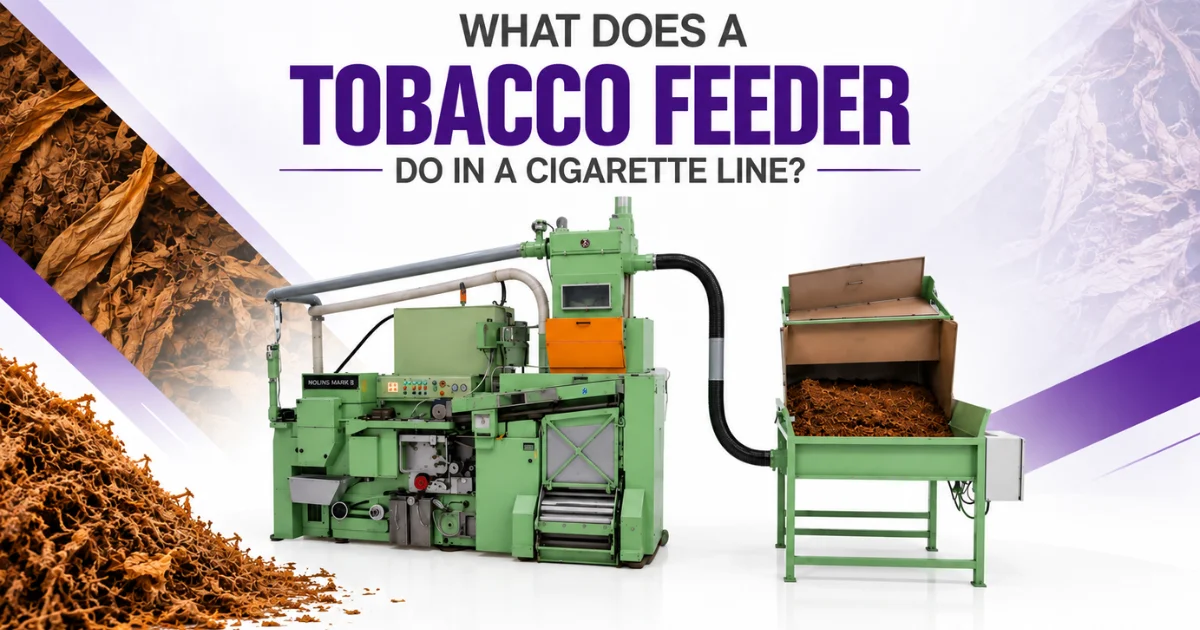
A tobacco feeder keeps rod production consistent. Here's what it actually does, where it fits in the line, and which makers it works with.
A cigarette making machine can only produce a consistent rod if it receives a consistent supply of tobacco going in. That's the job of the tobacco feeder, a machine that rarely gets attention on its own but has a direct effect on everything downstream from it. Here's what a tobacco feeder does, and why it matters more than its size on the factory floor might suggest.
What a Tobacco Feeder Actually Does
A tobacco feeder takes prepared tobacco and delivers it to the cigarette making machine in a steady, even stream. Rather than tobacco arriving in uneven clumps or an inconsistent volume, the feeder spreads and layers it before it reaches the maker, so the machine downstream always has a predictable amount to work with. Without that step, a cigarette making machine has to compensate for whatever irregular flow it receives, which shows up as inconsistency in the finished rod.
Where It Fits in the Production Line
The feeder sits between tobacco preparation and the cigarette making machine itself, a connecting stage rather than a standalone process:
- Tobacco is processed and prepared upstream, including cutting and any stem flattening
- The tobacco feeder receives that prepared tobacco and evenly spreads and layers it
- The feeder delivers a steady, consistent volume to the cigarette making machine
- The maker, such as a Molins Mark 8 Post 64 or a Mark 9.5, forms that tobacco into the finished rod
If the feeder isn't keeping pace or delivering an even flow, no amount of tuning on the maker itself will fully fix the resulting inconsistency, the problem starts one step earlier.
Why Steady Flow Actually Matters
An uneven tobacco supply doesn't just risk visible defects. It affects rod weight consistency, which has real cost implications at scale, since both underweight and overweight rods create waste and quality issues. A feeder built to provide a steady, even flow reduces that variability before it ever reaches the maker, which is why this machine has more influence on your overall product consistency than its relatively simple function might suggest.
Compatibility with Your Maker
A tobacco feeder needs to match the maker it's feeding. Ours is built to work with both Mark 8 and Mark 9 class machines, covering models like the Mark 8 Post 64, Mark 8D MAX 15, and the Mark 9.5 range. If you're planning a line around one of these makers, confirming feeder compatibility upfront avoids a mismatch further down the setup process.
Adjustable Volume, Less Manual Handling
Production needs shift, and a feeder with adjustable volume settings lets you tune output without needing a different machine for every production target. Combined with automated handling, this also reduces how much manual tobacco handling your line depends on, which matters both for labor efficiency and for keeping the tobacco flow itself more consistent than manual feeding typically allows.
Do You Need to Think About This Machine Separately?
If you're sourcing a complete production line for the first time, it's easy to focus entirely on the cigarette making machine and treat everything feeding into it as an afterthought. In practice, the feeder is part of what determines whether that maker actually performs at its rated output consistently, not just in short bursts. It's worth specifying and confirming as deliberately as the maker itself, rather than assuming any feeder will do.
Frequently Asked Questions
Can a tobacco feeder be used with any cigarette making machine?
No. A feeder needs to match the maker it's feeding, both in mechanical compatibility and output capacity. Confirm compatibility with your specific maker model before assuming any feeder will work.
What happens if the tobacco feeder isn't keeping up with the maker?
The maker ends up compensating for an inconsistent or insufficient tobacco supply, which typically shows up as rod weight variation or interruptions in production, even if the maker itself is running at full capacity.
Does a tobacco feeder need regular maintenance?
Yes. Since it handles continuous tobacco flow, components involved in spreading and layering the tobacco are subject to wear over time. Routine maintenance keeps the flow consistent and prevents gradual output degradation that's easy to miss until it affects finished product quality.
Talk to Us About Your Production Line
Getting tobacco preparation, feeding, and manufacturing to work together as one consistent line is as important as any single machine's spec sheet. At Civic Tobacco Machinery, we help manufacturers plan a full line, from feeding through to the finished rod, rather than selling machines in isolation. Reach out to us and we'll help you work through what your setup needs.
WhatsApp us: +92 301 1111184
Syed Kashif Ali
CEO, Orchid Tobacco Dubai
As the Chief Executive Officer of Orchid Tobacco Dubai, Mr. Kashif Ali has built a multi-million-dollar enterprise with a strong international presence and clientele. His entrepreneurial vision and commitment to operational excellence have positioned Orchid Tobacco Dubai as a major name in global trade and manufacturing.