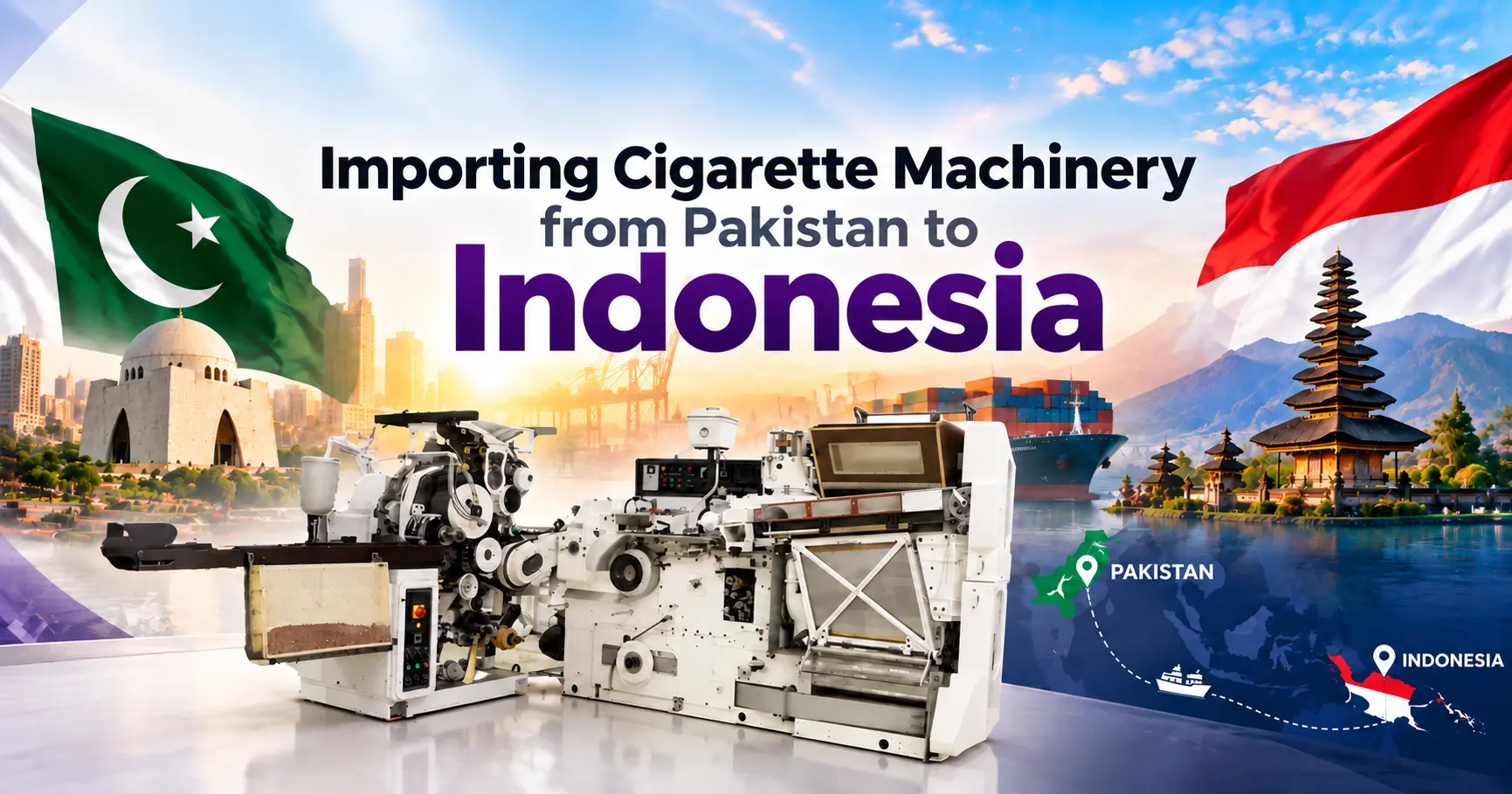
How to import cigarette machinery from Pakistan to Indonesia: documents, Karachi sea freight, customs clearance, timeline and installation steps.
Importing cigarette machinery from Pakistan to Indonesia usually takes about two to four months from a confirmed order to a machine ready for commissioning. Sea freight from Karachi to an Indonesian port accounts for roughly three to five weeks of that. The rest goes to machine preparation, export paperwork, Indonesian customs clearance, inland transport and installation. These are indicative ranges, and the exact timeline depends on the machine, the shipping route and how complete your documents are.
This guide walks through each step in order, lists the documents you need, and shows where delays usually happen. If you are still comparing sources, our page for a cigarette machinery supplier in Indonesia covers the machines and export support in one place.
The Import Process at a Glance
- Confirm the machines and specifications
- Check your Indonesian importer registration and permits
- Agree contract terms and shipping terms
- Machine preparation and export packing in Pakistan
- Pakistan export clearance
- Sea freight from Karachi to Indonesia
- Indonesian customs clearance
- Inland delivery, installation and training
Step 1: Confirm the Machines and Specifications
Everything downstream depends on a fixed machine list. Decide the line before any paperwork starts: the making machine, filter making machine, packing machine and box wrapping machine, plus any feeding or tobacco recovery equipment.
Confirm these points in writing:
- Cigarette size and format (diameter, length, filter type)
- Required output, in cigarettes per minute for making machines and packs per minute for packing machines
- Power supply and voltage at your factory
- Pack format, hard pack or soft pack
Our cigarette manufacturing machines range runs from the Mark 8 Post 64 at 1,800–2,000 cigarettes per minute up to the Protos 80 ER at 8,000 per minute. A fixed specification at this stage prevents change requests after the order is placed.
Step 2: Check Your Indonesian Importer Registration and Permits
The importing company in Indonesia must be registered to import. In general this means a business registration number (NIB) and an importer identification number (API), and the right API type depends on whether the machinery is for your own production use or for trading.
Tobacco is a regulated sector in Indonesia, so also confirm whether your business licence covers tobacco manufacturing equipment and whether any additional approval applies to the machine category you are importing. Rules in this area change, so confirm the current requirements with a licensed Indonesian customs broker before you finalise the order.
Step 3: Agree Contract Terms and Shipping Terms
The contract should state the machine list, specifications, payment terms, delivery terms and what is included in the supply, such as spare parts, tooling and documentation.
Shipping terms decide who handles what:
| Term | Meaning for an Indonesian buyer |
|---|---|
| FOB Karachi | Seller delivers to the ship at Karachi. You arrange sea freight, insurance and Indonesian clearance. |
| CFR / CIF Indonesian port | Seller arranges sea freight (and insurance under CIF) to the Indonesian port. You handle customs clearance and inland delivery. |
Buyers new to importing from Pakistan often choose CIF so that one party manages the ocean leg. Buyers with their own freight forwarder often prefer FOB. Either works if the responsibilities are written down.
Step 4: Machine Preparation and Export Packing
Before shipment, each machine is tested, dismantled where required, cleaned, protected against moisture and packed for sea transport. Heavy machines such as the Mark 9.5 Max S & Tray Filler, at around 7,800 kg, need crating and lifting points planned in advance.
Ask for a packing list that shows, for every crate, the contents, dimensions and gross weight. Your Indonesian clearance agent needs the same list, and so does the installation team when they unpack.
Step 5: Pakistan Export Clearance
Export clearance in Pakistan is handled through Pakistan Customs. The exporter files the export declaration, and the goods are examined and released for loading at the port.
Documents prepared on the Pakistan side usually include:
- Commercial invoice
- Packing list
- Export declaration
- Bill of lading (issued by the shipping line)
- Certificate of origin
- Insurance certificate, if the terms require it
Step 6: Sea Freight from Karachi to Indonesia
Machinery of this size moves by sea in containers or as break-bulk cargo. The two main entry ports for Indonesian buyers are:
- Tanjung Priok (Jakarta), the largest port, convenient for factories in and around Java’s west
- Tanjung Perak (Surabaya), convenient for East Java, where much of Indonesia’s tobacco industry is based
Direct services between Karachi and Indonesia are limited, so many shipments are transshipped through a regional hub. That is why transit is quoted as a range rather than a fixed number. Choose the discharge port closest to your factory to cut inland trucking time.
Step 7: Indonesian Customs Clearance
On arrival, your importer or customs broker files the import declaration with Indonesian Customs (Bea Cukai). Machinery for making tobacco products is generally classified under HS heading 8478, but your broker should confirm the exact tariff line, because it decides the duty rate and any additional requirements.
Plan for these clearance items:
- Import duty, where applicable to the tariff line
- Import VAT and income tax prepayment
- Port handling and storage charges
- Customs inspection, which can include physical examination of the cargo
The two most common causes of delay at this stage are mismatches between the invoice, packing list and bill of lading, and missing importer registrations. Check that all three documents describe the same goods in the same words before the ship sails.
Step 8: Inland Delivery, Installation and Training
After release, the cargo travels by truck to your factory. Confirm in advance that the site has clear access for long crates, a lifting plan, a levelled and cured floor, and the required power supply.
Installation and commissioning follow the same order every time: positioning, alignment, electrical connection, trial runs, then operator and maintenance training. A line with several machines, such as making, filter, packing and wrapping, is commissioned machine by machine and then run together.
Typical Timeline
| Stage | Indicative duration |
|---|---|
| Contract, specification and registration checks | 1–3 weeks |
| Machine preparation and export packing | 2–6 weeks (varies by machine) |
| Pakistan export clearance | 3–7 days |
| Sea freight, Karachi to Indonesian port | 3–5 weeks |
| Indonesian customs clearance | 1–2 weeks |
| Inland delivery | 2–7 days |
| Installation, commissioning and training | 1–3 weeks |
These figures are indicative. Do not treat them as a guarantee, and ask for a written schedule for your specific order.
Common Delays and How to Avoid Them
- Document mismatches. Use one master machine list and copy descriptions exactly across all documents.
- Unconfirmed permits. Settle licence and registration questions before the order, not at the port.
- Wrong discharge port. Choose the port closest to the factory.
- Site not ready. Prepare power, floor and access before the cargo lands.
- Late specification changes. Fix the machine list in Step 1.
Planning the Full Production Line
Most Indonesian buyers import more than one machine. A typical line combines a making machine, a filter making machine, a packing machine and a box wrapping machine, with tobacco feeding and recovery equipment ahead of the line. Shipping the line together keeps commissioning on one schedule. If you are weighing suppliers at the same time, read how to choose a cigarette making machine for the questions to ask.
Frequently Asked Questions
How long does it take to import cigarette machinery from Pakistan to Indonesia? Typically two to four months from confirmed order to commissioning. Sea freight is about three to five weeks of that, and the rest depends on machine preparation, customs clearance and installation.
Which Indonesian port is best for cigarette machinery? Tanjung Priok in Jakarta suits factories in west Java and the Jakarta area. Tanjung Perak in Surabaya suits East Java. Pick the port closest to your factory.
What documents are needed for the import? A commercial invoice, packing list, bill of lading, certificate of origin and the Indonesian import declaration, plus your importer registration. Your customs broker will confirm any additional documents.
Do I need a customs broker in Indonesia? It is strongly recommended. A licensed broker confirms the tariff classification, duties and permit requirements, and files the declaration on your behalf.
Can I get the machines installed after they arrive? Yes. Installation, commissioning and operator training are normally planned as part of the order. Agree the scope and schedule in the contract.
Which shipping term should I choose, FOB or CIF? Choose CIF if you want the seller to manage the ocean leg. Choose FOB if you have your own freight forwarder. Both are workable if responsibilities are written down.
Talk to Us About Your Indonesian Project
Civic Tobacco Machinery supplies cigarette making, filter making, packing, box wrapping and tobacco processing machinery from Karachi, Pakistan, and exports to Indonesia. To discuss a line for your factory, message us on WhatsApp: +92 301 1111184.
Kashif Ali
Tobacco Machinery Specialists, Karachi
Civic Tobacco Machinery supplies new and reconditioned cigarette manufacturing, packing, wrapping and used tobacco machinery across Pakistan.