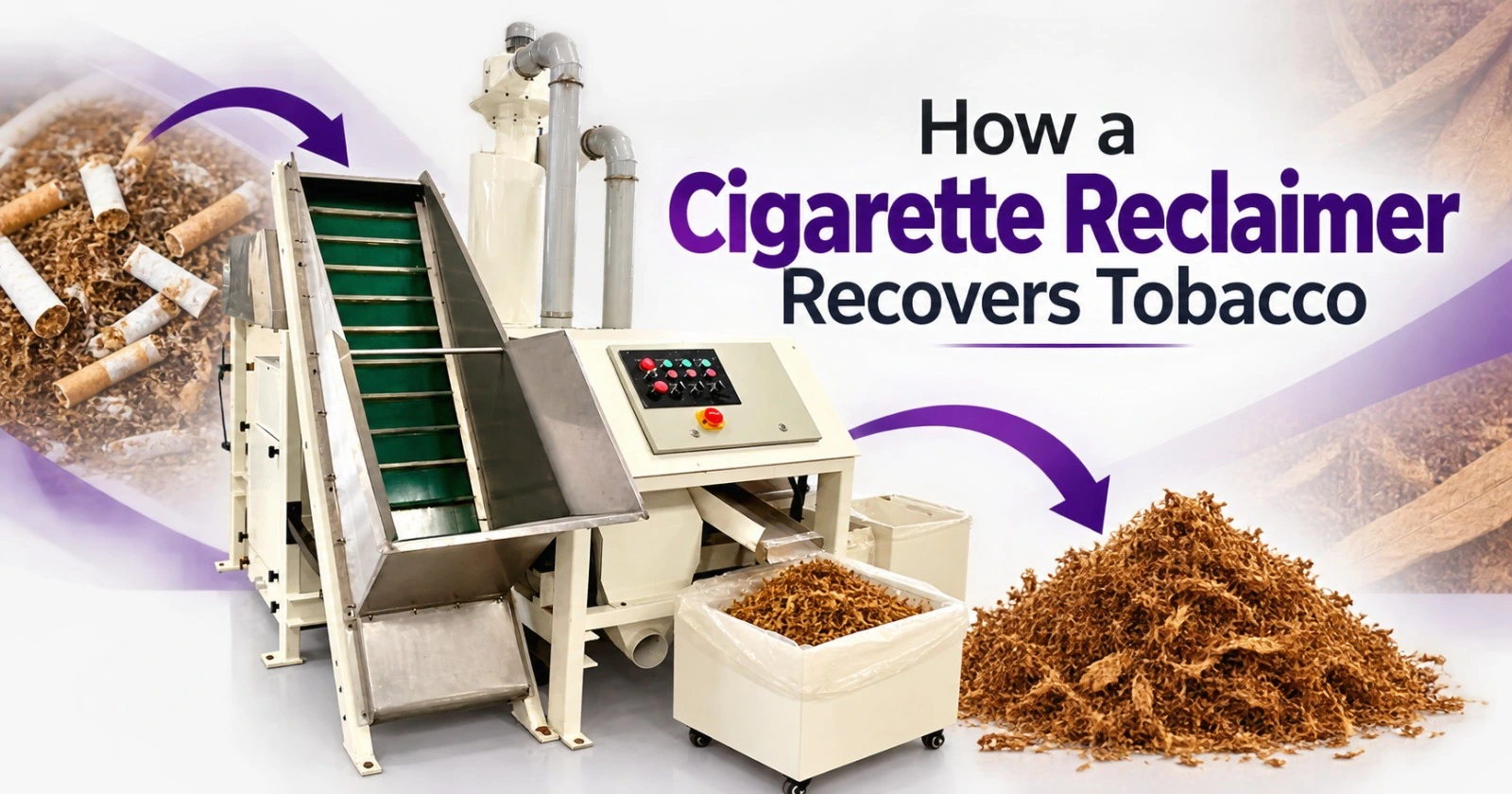
A cigarette reclaimer separates usable tobacco from rejected cigarettes so it can be reused. Learn how it works, its limits and how to size one.
A cigarette reclaimer takes cigarettes that the production line has rejected and separates the usable tobacco from the paper and filter, so the tobacco can go back into production instead of being thrown away. It sits beside the cigarette maker, handles only rejected product, and turns what would be waste into recovered tobacco.
This guide explains where a reclaimer fits, how the main reclaiming methods work, what cannot be recovered, and how to size one against your own reject volume.
Where a Reclaimer Fits in the Line
Of all the tobacco machinery on a line, the reclaimer is the one whose job is recovery rather than production. Every cigarette line produces rejects: cigarettes that fail the line’s checks and are removed before packing. Each rejected cigarette still holds good tobacco. A reclaimer is the machine that gets that tobacco back.
Among the cutter, feeder and reclaimer machines, the cutter prepares tobacco before the maker, the feeder delivers it to the maker in a steady stream, and the reclaimer works at the other end, recovering material from what the maker rejects. For the feeder’s role, see our guide on what a tobacco feeder does.
How Reclaiming Works
Reclaimers use different methods, but all of them do the same three things: open or empty the rejected cigarette, separate the tobacco from the paper and filter, and send the tobacco on for reuse. The main approaches are:
Air blow-out. Rejected cigarettes drop into a rotating drum. A cigarette is held by its filter tip and a jet of compressed air expels the tobacco from the paper tube. The empty tube, with the filter, goes to a separate collector.
Slicing and sieving. Knives open the rejected cigarettes, and a sieve separates the loose tobacco from the paper and filter pieces. The filter is kept intact, which avoids filter material contaminating the tobacco.
Vibrating sieve. A vibrating sieve separates the tobacco from the paper and filter components and sends it back to the maker’s hopper. The vibration can be adjusted to limit damage to the tobacco while sieving.
The method matters because it affects how much of the tobacco comes back clean and how gently it is handled.
What a Reclaimer Cannot Recover
A reclaimer cannot return 100% of what goes into it. Some of the rejected material is damaged, and some of the tobacco is lost in separation. Three limits are worth knowing:
- Quality. Reclaimed tobacco should be reused only up to a level that does not affect the quality of the finished cigarette.
- Contamination. Paper particles and dust must be removed from the recovered tobacco. Filters with liquid capsules can leak and contaminate it if they are damaged.
- Fines and dust. These are a separate waste stream and are usually handled differently from the tobacco recovered from reject cigarettes.
Reusing the Recovered Tobacco
Recovered tobacco is typically fed back into production as add-back, blended with fresh tobacco. Two points keep this safe:
- Keep the reused share at a level your blend and quality checks allow.
- Keep the recovered tobacco clean, because anything left in it travels straight back to the maker.
How to Size a Reclaimer
Reclaimers are rated in kilograms per hour. To check whether a rating covers your line, work out how much rejected product you actually produce:
- Take your maker’s output per hour (cigarettes per minute × 60)
- Multiply by your reject rate to get rejected cigarettes per hour
- Multiply by the weight of one cigarette (weigh a sample of your own product)
That gives the kilograms of rejected product per hour. The reclaimer’s rated capacity should comfortably cover it. For example, a maker running at 4,500 cigarettes per minute produces 270,000 cigarettes per hour, so a 1% reject rate is 2,700 rejected cigarettes per hour. Multiply that by your own cigarette weight to find your figure.
If you run several makers into one reclaimer, add their rejects together.
Civic Reclaimer Specifications
Our cigarette reclaimer is rated as follows:
| Specification | Value |
|---|---|
| Reclaim capacity | 120 kg per hour |
| Efficiency | 99.8% |
| Recovery rate | 90% |
| Operation | Simple |
Check the rated capacity against your own reject volume, using the calculation above, before choosing a reclaimer.
Frequently Asked Questions
What does a cigarette reclaimer do? It separates usable tobacco from rejected cigarettes, removing the paper and filter so the tobacco can be reused.
Does a reclaimer recover all the tobacco? No. Some material is always lost, and the reuse share must stay within what your quality checks allow.
Where does the recovered tobacco go? It is fed back into production as add-back, blended with fresh tobacco.
How do I know what capacity I need? Multiply your maker’s hourly output by your reject rate and by the weight of one cigarette. The reclaimer’s rated kilograms per hour should cover that figure.
Does every cigarette factory need a reclaimer? Any factory that produces rejected cigarettes loses usable tobacco without one, and the loss grows with output.
Can one reclaimer serve several makers? Yes, if its rated capacity covers their combined rejects.
Talk to Us About Your Line
Civic Tobacco Machinery supplies cigarette making, filter making, packing, box wrapping and tobacco processing machinery from Karachi, Pakistan. To match a reclaimer to your maker’s output, message us on WhatsApp: +92 301 1111184, or email info@civic-tobacco-machinery.com.
Saad Ali
Tobacco Machinery Specialists, Karachi
Civic Tobacco Machinery supplies new and reconditioned cigarette manufacturing, packing, wrapping and used tobacco machinery across Pakistan.