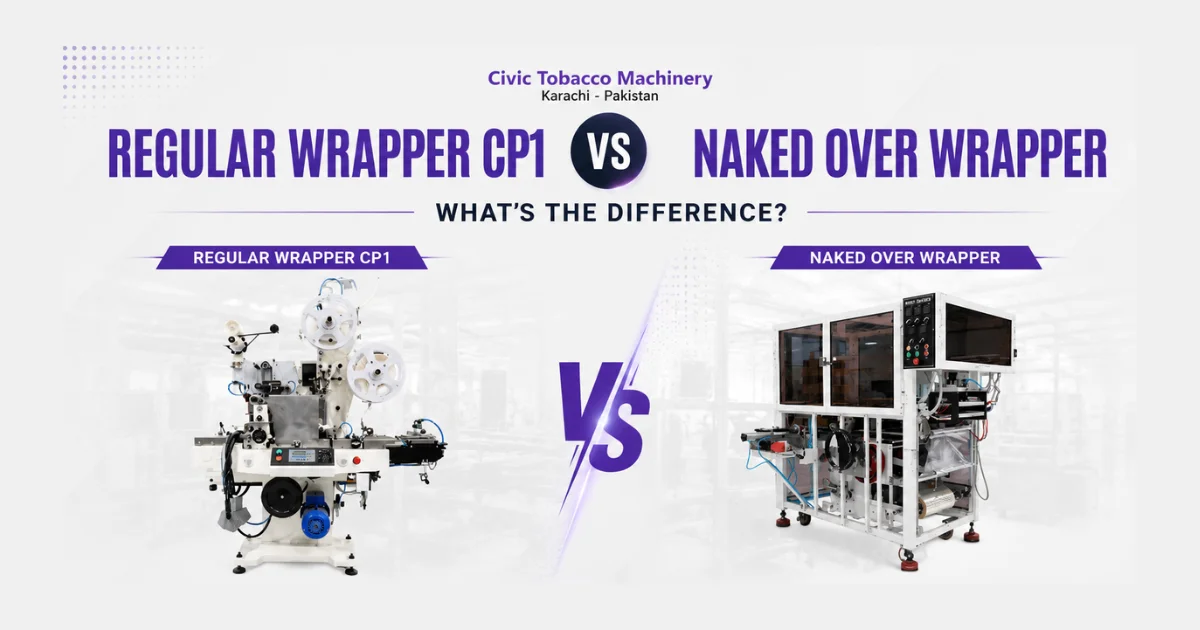
If you're setting up or expanding a cigarette packing line, it's easy to assume "wrapper" and "overwrapper" mean the same thing. They don't. The Regular Wrapper CP1 and the Naked Over Wrapper both sit in our wrapping and boxing range, but they do different jobs at different points in the line. Here's how they actually differ, and which one your setup needs.
Quick Comparison
| Spec | Regular Wrapper CP1 | Naked Over Wrapper |
|---|---|---|
| Speed | Up to 250 packs/minute | 25 outer packs/minute |
| Power Requirement | 6 KVA | 6 KVA |
| Air Pressure | 0.05 m³/min | 0.05 m³/min |
| Best Suited For | Pack overwrapping & high-volume packing lines | Outer pack overwrapping & end-of-line sealing |
What the Regular Wrapper CP1 Actually Does
The Regular Wrapper CP1 overwraps individual cigarette packs, running up to 250 packs per minute. It sits directly downstream of your packing machine, whether that's an HLP-200 or an HLP-225, wrapping each finished pack before it moves on to cartoning. Because it works at pack level, its speed needs to roughly match your packing machine's output, or it becomes the bottleneck right after the stage you just optimized.
What the Naked Over Wrapper Actually Does
The Naked Over Wrapper works further down the line, at the outer pack or carton stage rather than the individual pack stage. Running at 25 outer packs per minute, it's built for end-of-line sealing, wrapping the larger outer packs that already contain multiple individual packs. It's a lower-speed machine by design, since it's handling far fewer, larger units per minute compared to a pack-level wrapper.
Why the Speed Difference Doesn't Mean One Is "Better"
At first glance, 250 packs per minute versus 25 outer packs per minute looks like a big gap in capability. It isn't. These two machines aren't competing for the same job, they're built for different stages of the same line. A single outer pack typically contains multiple individual packs, so a much lower outer-pack speed can still keep pace with a much higher individual-pack speed further up the line. Comparing their raw numbers side by side without accounting for what each one actually wraps is a common point of confusion for first-time buyers.
Power and Air Requirements Are Identical
Both machines run on 6 KVA power and 0.05 m³/min air pressure, so neither one requires a different infrastructure setup from the other. If you're planning to install both machines as part of a complete packing line, you can plan your factory's power and air supply around the same requirements for each.
Do You Need Both, or Just One?
Whether you need one or both machines depends on where your current line stops. If your packing line ends at the individual pack stage and cartons are wrapped manually or by a third party, the Regular Wrapper CP1 alone may be enough. If you're building out a complete end-to-end line, from packing through to sealed outer cartons ready for shipping, you'll typically need both: the CP1 for individual packs and the Naked Over Wrapper for the outer carton stage.
Matching Wrapping Machines to the Rest of Your Line
Neither wrapping machine operates in isolation. Before finalizing your setup, check both machines' speeds against your cigarette packing machine's output, since a wrapping stage that's slower than your packer will eventually create a backlog regardless of how well each individual machine performs.
Talk to Us Before You Decide
Every factory's line is laid out a little differently, and the right combination of wrapping machines depends on your actual packing speed, product format, and how far your line extends toward finished cartons. At Civic Tobacco Machinery, we help manufacturers map out a complete line, from maker to packer to wrapper, so nothing becomes an unplanned bottleneck. Reach out to us and we'll walk through your setup with you.
WhatsApp us: +92 301 1111184
Mustafa Qureshi
Tobacco Machinery Specialists, Karachi
Civic Tobacco Machinery supplies new and reconditioned cigarette manufacturing, packing, wrapping and used tobacco machinery across Pakistan.